Waste Reduction Resource Hub
Supported by the Green Enterprise Hub through Westmorland and Furness council and the UKSPF FundWaste Reduction Resource Hub
Welcome to our Waste Reduction Resource Hub support by the Green Enterprise Hub through Westmorland and Furness council and the UKSPF Fund.


Whilst we understand that waste isn’t on the top of everyone’s to do list, understanding your waste and how to manage it can have a really positive impact on both your business and the environment, whilst saving you more money than you think.
As of March 2025, under the new Simpler Recycling legislation, businesses with 10 employees and more must separate dry recyclables into dedicated containers and ensure food waste is collected separately, regardless of the amount produced. Businesses with fewer than 10 employees have until March 2027 to comply.
The legislation will require you to separate out:
- Glass, such as drinks bottles and rinsed empty food jars
- Metal, such as drinks cans and food tins, empty aerosols, aluminium foil, aluminium foil food trays and tubes
- Plastic, such as rinsed empty food containers and bottles
- Cartons used for food, drinks and liquids
- Paper and cardboard
- Food waste
It will be important to make sure you separate out the right materials and avoid contamination by any non-recyclable materials
If you need guidance on preparing for the Simpler Recycling legislation and what your business needs to do to comply, we recommend visiting https://businessofrecycling.wrap.ngo/
We also recommend contacting your current waste provider as many already have plans in place and are offering free waste audits.
The best way to reduce your waste is to avoid it in the first place. One key area where food and drink businesses can make a significant impact is through reducing their food waste or food loss. Food is often the heaviest part of your waste so it can be more costly to dispose of. Add into that the cost of the food itself, plus the cost of staff to prep and serve, and the energy this takes.
Businesses often underestimate the cost of their wasted food as they simply look at the purchase cost, however, WRAP (Waste & Resources Action Programme) estimate the cost as 10 times higher than this. On average food waste costs food and drink businesses £10,000 per year.
Our industry throws away 1.1m tonnes of food per annum and 75% of this could have been eaten. It is such a big problem that if food waste was a country it would be the 3rd highest carbon producer after the US and China!
But how do we tackle this problem?
We recommend taking the Guardians of Grub FREE online 15 minute cost saving skills course here.
Its packed full of useful help and advice to help you reduce your food loss.
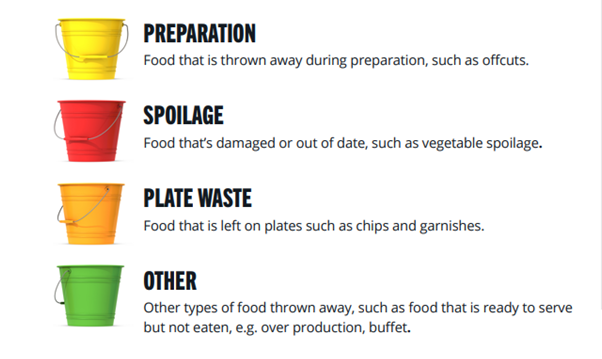
The course recommends separating your food waste into these four sections.
This helps you know where to focus your efforts and there are lots of great tools on the guardians of grub website to show you how to minimise these areas of waste.

Top Tips
- Know what’s in your store and freezer and use specials to use up items which need using imminently
- Use your prep waste in other dishes; crusts can be used as crutons and peelings in soup stock
- The two most wasted items coming back in the kitchen tend to be chips and side salads/garnishes. Offering dressings and simply to leave off the garnish can help reduce this and offering to swap out a side dish and upgrade to chips also works well.
So, once you have reduced your waste, what else can you do?
-
- Offer customers doggy bags to take left-overs away
- Use one of the food re-distribution apps like OLIO or TooGoodToGo
- Donate packaged goods to foodbanks
- Local food waste charities often take packaged as well as fresh items
To lean more about how to re-distribute food safely watch our webinar HERE. We also have guest slots from the app providers and a local charity.
And if all else fails…compost!
If you have room, on-site composting is a more sustainable way to dispose of your food waste and can provide compost for your property. Watch our webinar with Garden Organic and Cumbria Action for Sustainability HERE to find out more.
Case Studies
If you want ideas and inspiration from local businesses who are actively reducing wasted food then download our case studies below.